Two Hearts
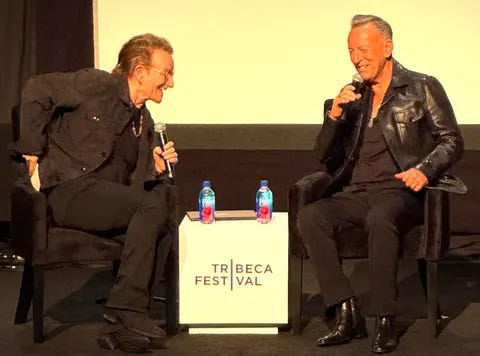
Bruce Springsteen and Bono

Thursday, July 9, 2026 Entry #237
I have written quite a bit about the Springsteen-Dylan nexus (See Highway 61 and Cringe Rocker), but now is a good time to explore Springsteen’s connection to another of my favorite artists, Bono of the rock band U2. The impetus was a recent event in which Bono presented Springsteen with a social justice in the arts award, and I will jump into that shortly.
But first, I’ll just say that there are a lot of differences between the two superstars. Springsteen was ‘born in the U.S. A.’ and Bono is from Ireland. Though both play rock and roll music, their respective sounds are quite different. U2 is a famously egalitarian and democratic band-though he is a highly charismatic lead singer, Bono is still exactly one-fourth of the band’s decision making—while Springsteen is by design the boss of his E Street Band.
Above all, they came of age in different rock epochs. Springsteen’s debut album came out in 1973, while U2’s first release wasn’t until 1980. True, we’re talking about the same 10-year period, but a lot happened in between. Springsteen represented what the punk/new wave movements that U2 came out of wanted to symbolically set aflame.
And yet, as both of their stars have lasted through the test of time, Springsteen and Bono’s commonalities have become manifest. Whatever generational chasms existed between them have dissipated—by now Bono has joined Springsteen in the elite group of rock’s elder statesmen. Both have a passion for creating intimacy and connection with their massive audiences, they both can swing between sacred and profane, both know how to write a proper anthem and engage their crowds in cathartic sing-a-longs of them, both are hyperarticulate and unafraid to incorporate spoken word stories and messages into their concerts, and both have written memoirs that are far more literate than your average rock autobiography. Both have thrown themselves into progressive causes and politics, and both artists have songs titled “Two Hearts,” making that a natural title for this blog post.
So, it was no surprise when Bono was tapped to present Springsteen with the Harry Belafonte Voices for Social Justice award from the Tribeca Film Festival on June 13, 2026 (there was also precedent—it was Bono who made the induction speech for Springsteen’s entry into the Rock & Roll Hall of Fame, and a few years later, Springsteen returned the favor). According to the event’s press release, the two would also engage in an onstage dialogue (nothing was said about musical performances, but it was a good bet there would be some). I admit I didn’t know anything about the lower Manhattan festival until I caught wind of Springsteen and Bono’s participation this year. Turns out that the event was formed in the aftermath of the 9/11 attacks, and it was co-founded by noted actor Robert De Niro and film producer Jane Rosenthal. The organization’s self-description says that it is a “celebration of storytelling and a prime destination for independent cinema and emerging voices.”
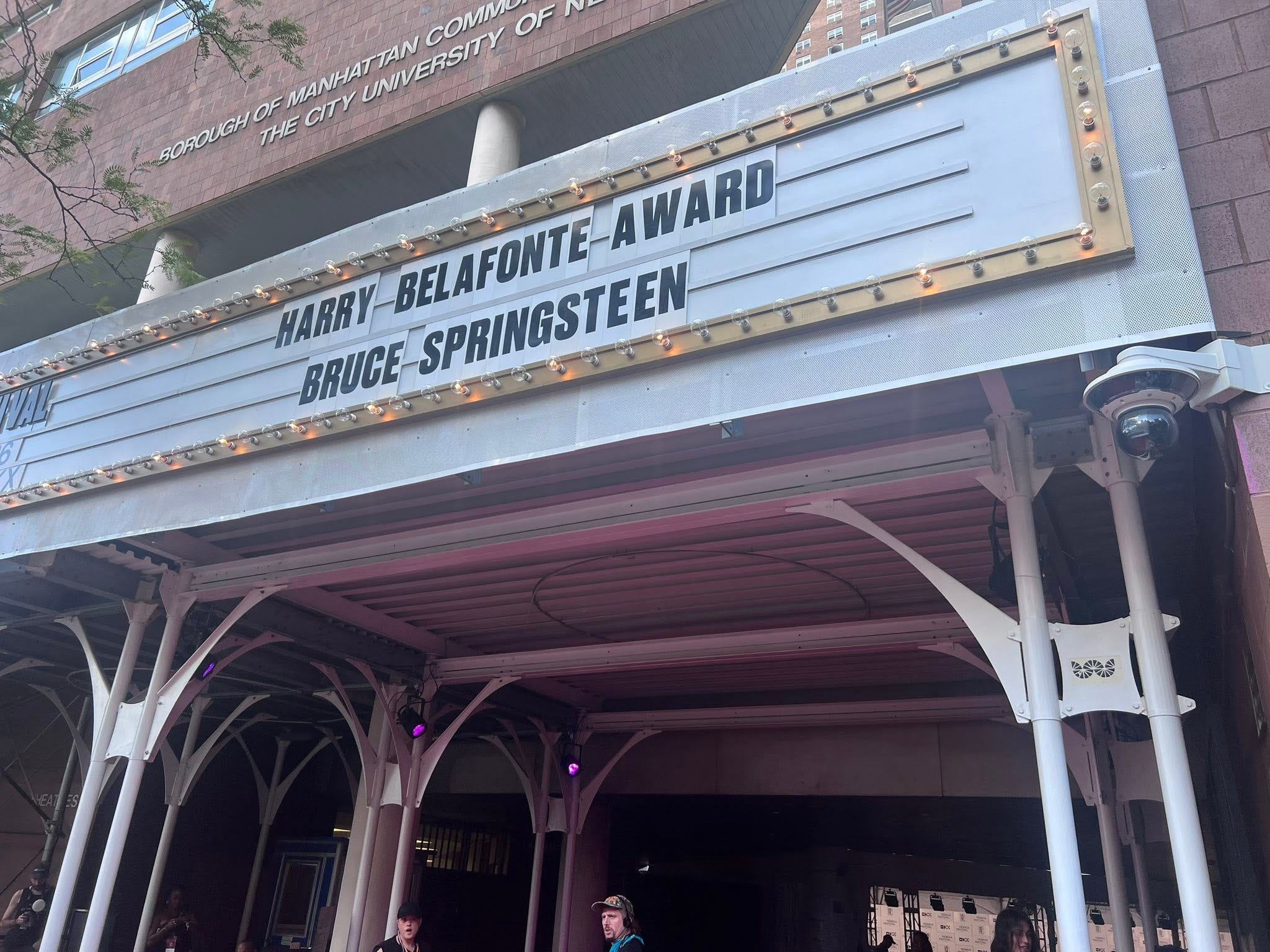
I can tell you that I very much wanted to attend. I have seen both Bono and Springsteen in arenas where they talk more than they sing (Springsteen on Broadway and Bono’s one-man show Stories of Surrender), and I find both musicians to be incredibly compelling as spoken-word artists. The two of them, Bruce Springsteen and Bono, have a way of expressing themselves culturally, spiritually, politically, emotionally, and literarily that is in perfect alignment with how I think and feel. The Tribeca event quickly sold out, but I soon found a reasonable ticket on the second-hand market. But, I had too many work obligations that weekend, and I regretfully took a pass.
A few video clips have emerged from the event (which proved to me that I shouldn’t have missed it!), but I wanted more. I wrote an email to a senior Rolling Stone writer who had posted a nice article about the event with extensive quotes from Springsteen and Bono, and he graciously sent me the audio recording of the entire thing (I immediately made a written transcript from it). So, though I was not there, I feel competent to cover the proceedings for Spirit In The Night readers.
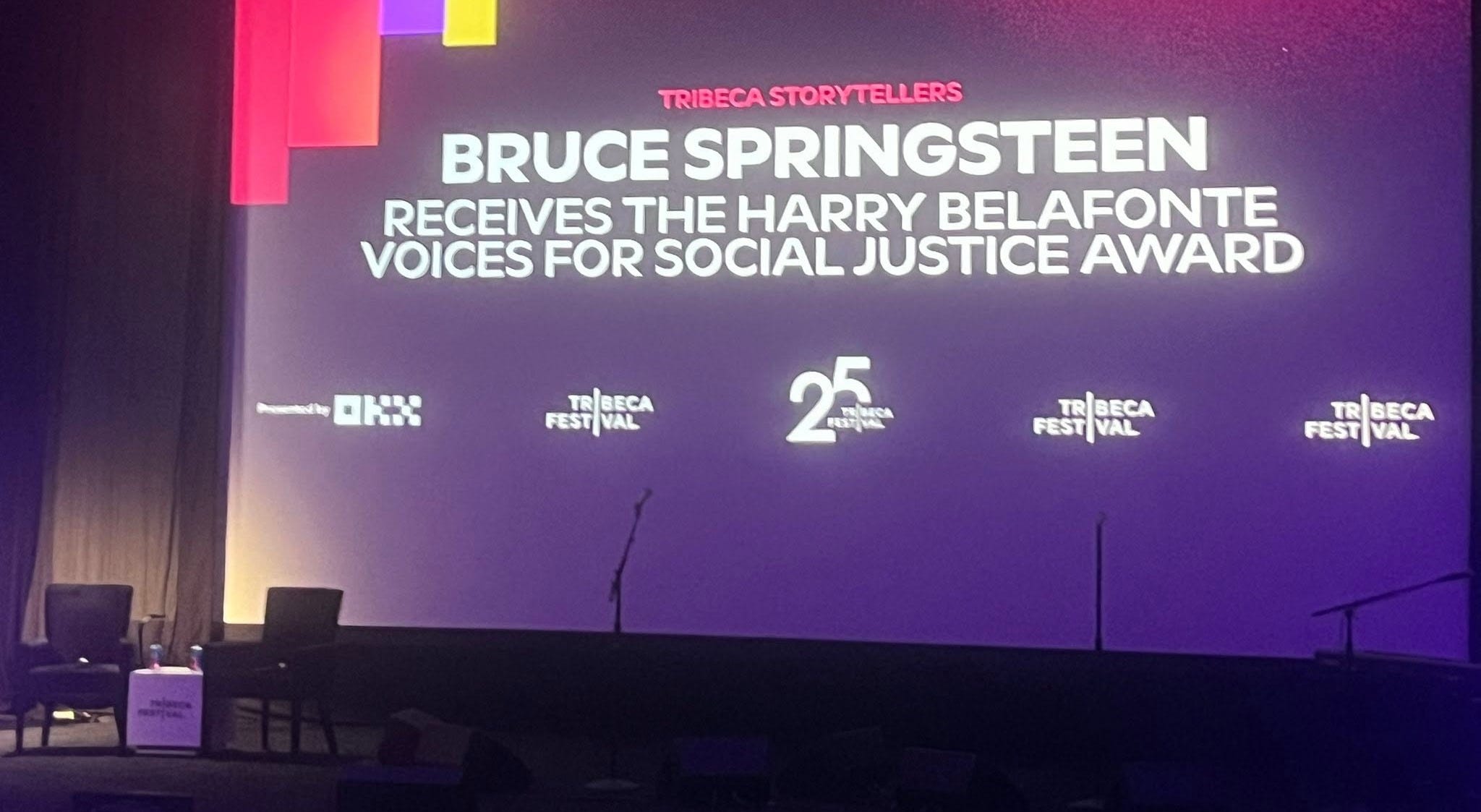
First up was De Niro who was as effusive about Springsteen as he was vicious concerning the current president of the United States:
“Bruce Springsteen. This is a man who knows how to use his voice. He uses it to move people with the music he creates and performs. He uses it to give voice to the powerless. And he uses it to lead the resistance. He is fearless and direct. He knows what the problem is, and he names it—Donald J. Trump! And his feckless enablers. That’s so important because this isn’t about reasonable disputes on policy. This is about the corruption and megalomania of one person. Bruce Springsteen puts a face on it and he does it with the words of a poet. My friend Bruce Springsteen is leading the way.
There was a Springsteen quote from the tribute video that was played for the (lucky) audience that resonated with me. “You do your best work and you hope that it pulls out the best in your audience,” Springsteen said, “and that some piece of it spills out into the real world, and in people’s everyday lives and takes the edge off of fear.”
Next were some kind words about Bono from Jane Rosenthal. She said, “I’d like to introduce a musician and humanitarian who has spent decades using art as a voice of change and a force of change. Bono has been a steadfast activist in the fight against extreme poverty, HIV-AIDS, and for human rights around the world. He has been a friend of this festival since day one. We’re honored to have him here tonight.”
Bono came up to the podium and proved the “day one” boast to be correct when he revealed that he had performed at the very first Tribeca Film Festival, twenty-five years ago. He recalled from that inaugural event how moved he was that for De Niro and Rosenthal, what happened on September 11, 2001 were not only attacks on New York City and the U.S.A., but on their own beloved neighborhood.
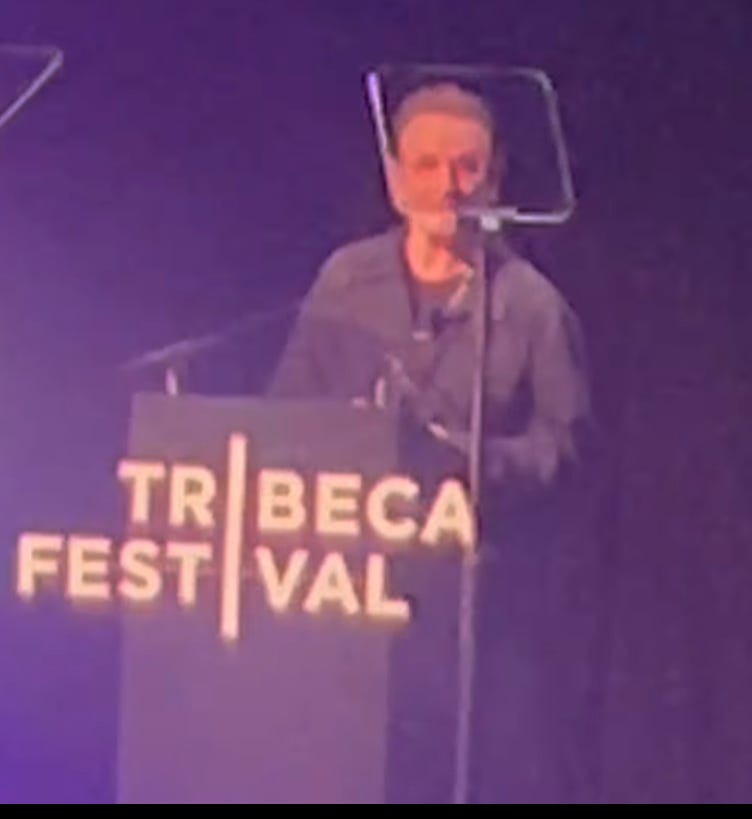
After that, it was all about Springsteen (well, it’s Bono, so it was also about him too!). As I knew I would, I drank in and loved Bono’s words, so I am just going to reprint most of his award presentation speech, breaking in occasionally with small amounts of context and commentary. I’ll also put what I took to be some of the most poignant parts in bold:
“I am a warmup act for a man who’s never had a warmup act. I’m here as a fan also, pretending to be a friend. I was 14 in 1974, and I had the shittiest year. I lost my mom, I lost my way. Got dumped by my girlfriend for an older man, whose name was Keith Darling. He was 15. When I turned 15 myself in May of 1975, I was off to being very good at being no good, but then that August, Bruce Springsteen released ‘Born to Run,’ and part of me stopped running. In November, Patti Smith put out ‘Horses.’ Wow. The next February, I witnessed Robert De Niro play Travis Bickle in ‘Taxi Driver.’ This. blows. my. mind. Then came April and the first Ramones album. All this vivid confrontational art coming out of this vivid city, New York City.
By my 16th birthday, I knew exactly what I wanted to do with my life, confront it. That same September, I met Edge, Adam, Larry, and I started dating my darling Ali. So tonight, I thank you Bruce, Patti, and Bob (De Niro) for maybe saving my life and letting me into yours.”
For all of his braggadocio, Bono can also be humble and deferential. He’s clearly a music fan—I can totally imagine him geeking out to Born To Run as a teenager. I have long thought that Springsteen and Bono have a kind of sibling relationship. Bono, the kid brother, earnestly looks up to Springsteen (I mean, Bono just gave Springsteen props for saving his life!), while Springsteen (who certainly can be earnest himself), gets kind of snarky to Bono in the face of all the sincerity. You can tell Springsteen has affection and admiration for Bono, but, like many older siblings, it ain’t coming out without some subtle put-downs layered on top.
Bono then namechecked De Niro for obvious reasons, but also tipped his hat to the rocker/poet Patti Smith, who was billed to perform later in honor of Springsteen’s award.
Next, Bono talked a bit about the award’s namesake, the legendary singer and Civil Rights activist Harry Belafonte. Then, he artfully shifted to connect Springsteen to the movies. It is a social justice award given by a film festival after all.
“Every country finds its own way to tell its story. Italy told its story in painting and sculpture; Britain told its stories in plays; Ireland told and tells its story in poetry and pints…with half-pints. And, America tells its story in cinema.
Cinema is where the American dream was encoded before it was exported, and what followed American cinema around the world? American music: Jazz, rhythm and blues, and rock and roll breached every barrier, cracked open every wall. American music let freedom ring. To people in Europe and Africa and Asia, Ray Charles was America. Johnny Cash was America. Aretha Franklin was America. Harry Belafonte was America. Bruce Springsteen IS America.
Bruce made poetry from the voices of the people and set that poetry to music. We honor him tonight as musician and poet, and as an activist and a patriot. And, I would suggest, as we honor him here at the 25th Tribeca Film Festival, we honor him as a songster who’s also been making cinema this whole time. Stick with me: ‘The screen door slams, Mary’s dress sways.’ Screenwriting? ‘Man walking along the railroad tracks, going someplace, there’s no going back. Highway patrol choppers coming over the ridge, hot soup on a campfire under the bridge.’ Establishing shot. ‘I saw her standing on her front lawn just a-twirling her baton. Me and her went for a ride, sir, and ten innocent people died.’ It’s the opening of “Nebraska,” but it’s Terrence Malick set to music, is it not?
Yes. A most cinematic figure, Bruce is the man alone—like Martin Sheen in Badlands, or Alan Ladd in Shane, or Clint Eastwood in pretty much everything—the man alone at the center of the great American story. But interestingly, that story always ends in community. The man alone will need company, if he’s going to try to make things better. The company of other misfits, a gang of misfits—of course I am talking about the E Street Band! I’m talking about Little Steven. I’m talking about Jon Landau even, (though) he might not like to be considered as a misfit. I am certainly talking about Patti Scialfa. Who, more than anyone in the world, figured out the puzzle of this man while she herself refused to be cracked. A complicated fucker! Anyway, you need, we need such extraordinary people in our lives.”
I should point out that even if Bruce is the movies, he never wanted to be in one. He could write a character, but he never wanted to play one. Bruce Springsteen may have become one of the most visible Americans on the planet Earth though never appearing in the widescreen cinema he so loved. He made his music widescreen instead. When Jon Landau finally talked Bruce into making a video for “Dancing in the Dark,” he had to organize Brian DePalma…can you imagine? And Courtney Cox, for God’s sake!
Just in his 40’s, I, the student, questioned the professor about rock and roll music on late night TV. Bruce offered me some sage advice. I can’t ‘do’ Bruce, but…(he tries a Springsteen impression anyways) ‘Be selective when handing other people the remote control! These are people you don’t know who can turn your band’s volume up or down.’ I said, ‘In the studio, the television studio?’ He said, ‘No, at home! Worst, they might go into the kitchen and make a cup of coffee during a song that took you months to write!’
Bruce is not television. He can do theater, but he IS cinema. Lights go down, and there he is, at 124 frames a second, 124 times larger than life, surround sound, so from intimate whisper to bellicose roar, a life turned up to 11, always though cutting away to the guy in the corner, the guy sitting alone, that’s carrying something no one else can see. But, Bruce can see it. Bruce can feel it. And more than that, Bruce can sing it, because in some ways Bruce is that guy in the corner.
I once had the audacity to ask this great songwriter why he didn’t write more about himself, and I received one of the few cross looks I’ve had over the years from the only man I will ever call Boss. I was 24, to be fair. He says, ‘Why would anyone be interested in my life? I don’t have much interest in writing about famous people. Infamous, maybe. I’m more interested in the lives of the people we walk by and don’t see. Why would anyone be interested in my life?’ Good question to ask, sir, but an easy question for everyone in this room to answer. We are all more interested in you than we should be. We have seen the present and its name is Bruce Springsteen.”
I just love Bono’s ending. It points to the gap between Springsteen’s humility (why would anyone be interested in my life?”) and his actual exalted position in society. Bono again displays his fandom (“We are all more interested in you than we should be”), and he draws on the iconic Jon Landau line about Springsteen being rock and roll’s future, which actually still rings true. Springsteen seems as integral, vital, and in the spotlight today as he was in his supposed heyday in the 1980’s.
With Bono’s presentation complete, Springsteen strolled onto the stage to thunderous applause and immediately pulled the big brother act. “Silver-tongue bastard, that one,” he said to and about Bono with equal parts sincerity and sarcasm in his voice. It was a great moment. Springsteen then accepted the award (and proved that he deserves it) by saying:
“I really want to accept this for all the citizens of Minneapolis and Los Angeles and Portland, who stood against the federal invasion of their cities this year. So, I’ll take this and keep this in their name.”
He then told a funny story about Robert De Niro:
“Nobody insults Trump better than Bob. I had this experience—I was at the Tony Awards, and Bob says he’s going to introduce me and I go, ‘Geez that’s fantastic, Bob’s one of my heroes.’ So, I’m backstage, Bob comes out. I had this arrangement of “My Hometown,” and I’m thinking, this thing is gonna kill everybody—there’s not gonna be a dry eye in the house or any living room in the United States when I’m done with this. I’m feeling really good and really confident. So, Bob comes out and he goes, ‘Fuck Donald Trump! Bruce Springsteen!’ You know, it just fucked the whole thing up. I said, ‘why did you do that, you can’t come out after someone says, ‘Fuck Donald Trump.’”
During the dialogue, Bono was in his angsty mode, which caused Springsteen to be a little flippant in return. Bono was wondering out loud about being susceptible to charges of elitism, and wondering if openly leftist stars like Springsteen and himself were alienating large segments of their fan base. Springsteen quickly dismissed the thought:
“I don’t know, I warned everybody what the tour was going to be like so they didn’t waste their money before they came in. I figured that I did my job, and it was ever man for himself after that!”
Springsteen did ultimately dial it back somewhat. He talked about commonalities and dignity for all people. He said that he always strives to maintain humanity in his art, in his audience, all the while trying to maintain his own humanity.
At one point, Bono said to Springsteen, “We in U2—we’ve been watching you. We toured the world together for Amnesty International, we are comrades, we are always your students.” Bono went on to say that one of the things he has observed about Springsteen is that he seemed to make everyone, regardless of politics, feel welcome at his concerts…to which he added, “for most of his career.” That seemed to me like an effort to push Springsteen on his latest explicitly anti-Trump single and tour. “Do you feel conflict, are you torn,” Bono asked Springsteen, “if people say, they used to come to your shows but they won’t now? Have you made peace with that?”
Springsteen’s reply demonstrated a firm resolve and belief that he is doing what needs to be done at this particular place and time regardless of any fallout:
“I don’t know. There’s that classic folk song, ‘Which side are you on?’ You do have to make your stand, and you follow your beliefs, and you have to have the faith that they will be explicable and understandable by your fellow citizens.”
At this point, Springsteen started talking about a dearth of leadership, about the need for somebody to emerge “with the capacity to speak to all the people about the sacred argument, about the need for compromise and common ground.” Right then, somebody yelled out to Springsteen from the audience, clear as a bell, “YOU!” Alas, Springsteen did not use the cheerleader’s outburst as an excuse to announce a run for public office. Instead, he again demonstrated his humility:
“No. I don’t really consider myself an activist. I’m a little embarrassed to get this award because I feel like at best I’m a concerned citizen. What do I do, you know? I sing my songs, I say a few things, and wish for the best. I do a little bit here, a little bit there. (turning to Bono) You, you’re more of an activist than me. So many people do more than I do.”
There it was! Finally, a “rose” from Springsteen to Bono. Awww.
Here is a piece of the conversation from a video posted on YouTube:
Bono quickly returned the favor, and spoke again about how Springsteen served as a rock star role model to Bono and U2, to the point where he joked about “robbing” pieces of Springsteen’s performance style:
“We followed you pretty much everywhere. Bruce can play an arena, U2 must be able to play an arena; he plays a stadium and figures out how to get intimacy (I once saw Bono say in an interview that he learned from Springsteen how to get audiences to sing non-verbal expressions—like repeated “whoahs—as an exercise in joyful community), we must be able figure it out. We find out what Bruce had done and accomplished, and we would rob it! Those operatic sounds, well he is Italian…it’s ok, my dad’s an opera singer, I can do that!”
Bono also brought up a socially conscious movie project that Springsteen helped define with his humane and haunting Oscar-winning theme song, “Streets of Philadelphia.” He said to Springsteen, “You were an AIDS activist before I was, and I don’t say that easily!” Bono remembered that when the song came out he wondered if Springsteen was becoming an electronic music artist. But then he realized that it was still Springsteen, as the Boss “put more soulfulness into that (drum) machine than anyone!”
Springsteen talked about how much his movie watching and his reading impacted his songwriting. As I listened, I thought right away about a recent interview with Springsteen’s manager and friend Jon Landau, who called his client a “synthesizer.” Landau went on, “Bruce takes everything he reads, every film he sees, and he’s got some ‘internal blender.’ He creates, out of found material, original work.”
Getting back to activism, Bono remarked that, perhaps unlike himself, Springsteen doesn’t “sign up easily.” He referenced Springsteen’s recent protest song about the ICE presence in Minneapolis saying, “Some songs change the atmosphere.” In addition, there was Springsteen’s recent, purposeful, and spontaneous decision to tour with that song and include some very pointed political messages. “For you to go on the road with your extraordinary band,” marveled Bono, “and leave your family, we know how serious it is that you are feeling for your country right now, and we are so grateful.”
Springsteen responded in length:
“I always work from the inside-out, so I’m sitting around, and I’m just pissed off, you know, and angry. For the past 50 years, I’ve put together a band that was built for hard times and built for times like these, and I’ve put together a body of work that was built for hard times and built for times like these, I was always singing for the moment and towards the moment, and I was interested in artists who encapsulated their moment in time. Which is what I’ve tried to do with my work, which is basically the second half of the 20th century and the start of the 21st, which involved the post-industrialization of America which affected so many people, and so many people did get left behind…If you do that long enough, you pray that you have a little impact on the culture because art has the chance to shape culture, culture shapes politics, culture and politics shape the nation, and at the end of the day, that is the business we’re in.”
The end of the dialogue portion was the part that made a little news. Bono praised Springsteen for writing all of these meaningful songs that are also melodic and popular. “What’s so great is that you took your hero Woody Guthrie, and got that sensibility onto pop radio. It’s an amazing thing to realize that you’ve written some great pop songs, as well as your great punk songs and great protest songs.”
Talking about pop reminded Bono of a story about himself and Springsteen that I had never heard before:
“I tried to get you to give me a song for a Gap commercial because they were supporting RED (Bono’s project combatting AIDS). I said ‘Bruce, this song, “Girls In Their Summer Clothes,” it’s like one of the great pop songs ever! Would you think about using it for a commercial for RED?’”
At this point, Springsteen interjected with the short answer he apparently gave to Bono all those years ago, “Nope.” Then Springsteen made this admission:
“That was a big mistake too. I should have said yes. It’s one of those songs, you have these songs where they became your own personal favorites, but the audience really doesn’t care whether they hear them that much or not. That’s one of them, I love that song and dammit, I still think back, Bono asked if I could put that thing on a commercial on television-I should have fucking done it! People would have heard it like a hit, so I have to apologize.”
First of all, “Girls In Their Summer Clothes” is an awesome song (See Entry #66)! Secondly, the headlines that came out about this interaction were pretty sensationalist. Here’s an example: ”Springsteen Apologizes to Bono for Rejecting Charity Commercial Request.” This is literally true, but I detected no controversy or “gotcha moment” on the recording; the tone of both rock stars was lighthearted and whimsical, so the tabloids should take a beat.
Now, at a U2 or Bruce Springsteen concert, there is more music than talking (though Bruce and Bono do talk more than most-which I for one appreciate), but at this event gabbing dominated over tunes. However, the Harry Belafonte Voices for Social Justice Awards event did end with a few stunning musical performances.
Directly after Bono and Springsteen finished their conversation, Patti Smith, a friend and collaborator of both of them, came onstage with her longtime accompanist Tony Shanahan. She introduced the first song by saying, “The most heartbreaking toll of war, disease, greed and bigotry—the greatest toll comes to children. May their suffering somehow be transformed into some kind of joy.”
They proceeded to play a Patti Smith song I had never heard before, “Peaceable Kingdom,” with its heartbreaking but hopeful refrain, “Maybe one day we’ll be strong enough to build it back again.” Before the music ended, Patti went into her poet mode, speak-singing Beatnik style some of the lyrics to her classic song “People Have the Power.”
Enter Bruce Springsteen. I am sure many in the audience were expecting the Boss and Patti to perform a duet of “Because the Night,” a song they co-birthed (Bruce wrote the bulk of it and Patti added a bridge; she recorded it and made it a hit, and the song has since become a live staple at Springsteen concerts) and performed together at this same festival in 2018.
Instead, they chose to play “People Have the Power.” Springsteen motioned for Bono to join them. At first, Bono seemed uncharacteristically reticent to take a spotlight. With her powerful voice, Patti Smith said, “You have been summoned, you have all been summoned!” Hence, the Tribeca Film Festival audience was treated to the rare sight of Bruce Springsteen, Bono, and Patti Smith, these three icons of rock, poetry, and activism, all performing together.
The song choice was truly perfect for the moment. In between refrains of “People Have the Power,” Patti Smith interjected phrases like, “Believe it!” “Make it so!” To dream!” “To vote!” “To march!” “To rule!” “To love!” “To wrestle the world from fools!”
And near the end, she exclaimed, “I believe everything we dream can come to pass through our union. We can turn the world around, we can turn the Earth’s revolution! Don’t forget it. Use your voice!”
Fittingly, the honoree ended the event on his own, performing yet another gorgeous rendition of “Land of Hope and Dreams,” which seems to be Springsteen’s song of choice at these kind of one-shot events these days.
Congratulations, Mr. Springsteen, and thank you Bono! (Have I mentioned I am still kicking myself for missing this one?).
Love that you were given a transcript! Thanks for all the detail!