"I Took My Fun Seriously"
Connections

Sunday, September 1, 2024 Entry #198
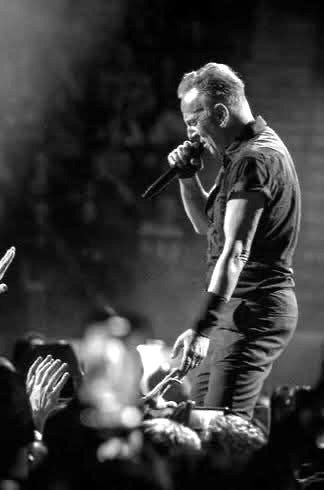
Even in his role as a rock star, sometimes viewed as a frivolous endeavor, Bruce Springsteen clearly has a serious side. Onstage, Springsteen will at times hush his audience in order to tell a searing personal story, speak out about an issue of social justice, deliver a message of hope, or give advice. On this current tour, Springsteen speaks directly to issues of mortality, paying tribute to loved ones who have passed away and pledging to carry on with vitality in their spirit. A number of Springsteen’s songs address weighty topics such as war, poverty, depression, and racism.
At the same time, Springsteen often also embodies pure fun. During his concerts, Springsteen dances, acts playfully with his bandmates, and performs a huge body of songs that are simply about having a good time.
Seeing Bruce Springsteen live is to watch him masterfully toggle between those two modes, serious and fun. Springsteen has said that when he made his 1980 The River album, his intent was to recreate on record that yin and yang quality of his concerts. It is no accident then that the double disc goes back and forth between exuberant party or “roadhouse” songs like “Sherry Darling,” “Crush On You,” and “Ramrod,” and more brooding and contemplative numbers like “Independence Day,” “Wreck On The Highway,” and “The River.”
There is at least one aspect of Springsteen’s performances where the fun and the serious converge, and that is with Springsteen’s clear yearning for connection. Springsteen displays a deep desire to connect to his audiences, he wants each fan to connect to their own vitality and potential, and he works hard to ensure that everyone present feels truly connected to one another. Ultimately, Springsteen’s goal to facilitate a connection to a spirit (in the night) that is even bigger than all of the individual selves gathered put together. As Springsteen said in his Broadway show, “I took my fun seriously.”
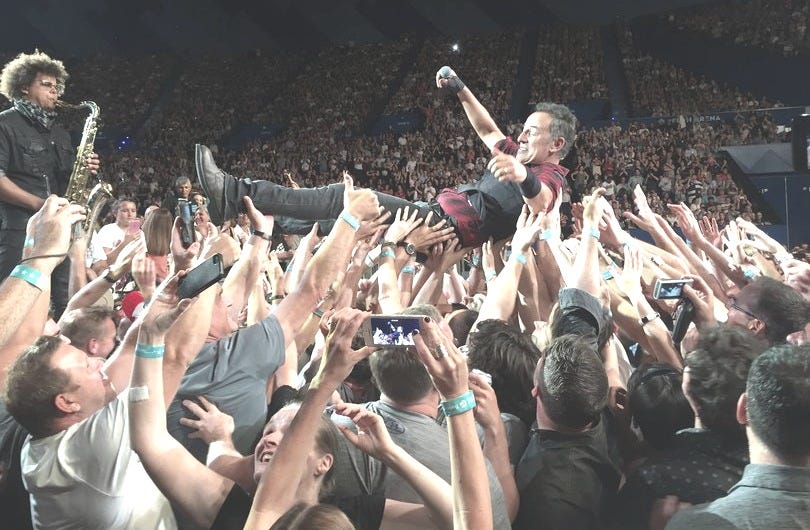
Some of the most captivating and joyful moments during a Bruce Springsteen concert happen when he immerses himself with the crowd, breaking down the separation that so often exists between performer and audience. Springsteen’s stage setup always includes a way for him to wade into the audience. Until fairly recently, Springsteen even regularly crowd surfed, reaching fans well beyond those in the front rows. He joyfully grabs every outstretched hand that he can, pulls fans onstage to dance and sing with him (including young kids), encourages mass sing-a-longs, and engages in shouted conversations with audience members who bring creative song request signs.
However, behind all this romping, as riotous as it can be, is a truly serious mission. Springsteen believes that all of the joy these connections he makes happen at his shows have transformative, even life-changing powers. It has long been Springsteen’s conviction that rock music brought him out of the narrow circumstances of his upbringing into a richer, more enlightened, grandiose, and meaningful life. Now, Springsteen feels it is part of his “job” to similarly lift people up and out of their own forms of drudgery through the healing and redemptive powers of music and impassioned performance. The line that gave the upcoming Springsteen movie its title, “Hey ho, rock ‘n’ roll, deliver me from nowhere” is included in two Springsteen songs, and he means it with all of his heart. Rock music uplifted, inspired, enlivened, and yes, saved Bruce Springsteen’ life, and now he wants the same for everyone, to bring us all along for the ride.
“I am trying to be a tool in helping you repair yourself, put yourself back together, find your wholeness, and assist you in transcending to some higher level of your life—these are the greater goals at night when we perform. And, we’re going to shout that thing to you, try to get you to stand up!” -Bruce Springsteen
Besides providing entertainment, Springsteen’s stock-in-trade is performing in such a way as to allow his fans’ senses to fully come to life. He wants the songs, the beat, the lights, the passion, and the communal energy of the shows he puts on to elicit a heightened sense of presence, vibrancy, and immediacy. This is the kind of ecstatic and embodied sensation that can lead to increased hopefulness, determination, and revitalization. The destination is higher ground.
From the stage, Springsteen often yells out, “Is there anyone alive out there?” This is such an integral plea for the Boss that he made it the centerpiece lyric for his 2007 song, “Radio Nowhere.” That rhetorical question is Springsteen’s way of searching for audible (roof-raising cheers), visual (arms outstretched in awe and exclamation), and physiological signs (heart-pounding, pulse-quickening, emotion-stirring) that he is making those all-important connections happen.
It is a good thing, Springsteen stresses, to have a good time. But, it is an even loftier goal to bring along as many others into the fun as possible. During the 1999 tour that reunited Springsteen with the E Street Band, Springsteen developed a monologue that he repeated in one form or another at every single concert on the itinerary.
“I want to go to that river tonight. That river of life, that river of love, that river of hope, faith, and sexual healing. The river of a meaningful life. I want to go to that river tonight, and I want you to go with me. Because I need to go with you. Because you can’t get there by yourself.”
Springsteen’s songs often serve as overtures for connection. Even those compositions that are ostensibly about couples go beyond typical love songs and carry a more inclusive and universal message. In “Born To Run,” Springsteen is singing to more than just the character named “Wendy,” he is addressing all the “tramps like us” (See Entry #114). “Land of Hope and Dreams” (See Entry #83) starts with two lovers seemingly on their own in the world, but then they board a metaphorical train that carries with it a diverse group of humanity. In a documentary on the making of Born To Run, Springsteen refers to the elaborate piano introductions that he composed for the start of so many of the songs on that album as open “invitations” for his listeners to join him on the journey.
Bruce Springsteen takes that playful plea, “Is there anybody alive out there?” very much to heart. For me, and so many others, the message has been received.


